
I am an eternal optimist and firmly believe that every crisis provides an opportunity to define the future. In this blog, I have attempted to draw learnings from some of the successful world economies, which converted adversity into an opportunity to change the trajectory of their economic development, to catapult into a new orbit of sustained economic development.
For America, it was the Great Depression of 1929, post which it invested heavily in infrastructure which led to its massive interstate highway network. This laid the foundation of growth for its automobile industry, which in turn led to the employment boom and became the backbone of prosperity for its middle class.
In India, post Independence, the setting up of national institutions like the BARC, IITs, IIMs and public sector enterprises set the basic foundation for India’s economic development. Subsequently, in 1990, when India was on the brink of a financial crisis (had to pledge 47 tonnes of gold with the Bank of England to raise a loan of USD 405 Million to tide over a balance of payments crisis), she was pushed to take definitive steps to reform the economy by opening up and allowing market forces to determine investments rather than relying only on government sponsored development. These reforms dramatically changed the fortunes of the country in years to come.
Similarly, in China, as the country came out of the cultural revolution, it sought to reform the Chinese economy which was dominated by state ownership and central planning. From 1950 to 1973, the Chinese real GDP per capita grew at a rate of 2.9% per year on average. Starting in 1970, the economy entered into a period of stagnation. As a result after the death of Mao Zedong, the Communist Party leadership turned to market-oriented reforms to salvage the failing economy. The Communist Party focused on 3 key aspects 1. Population control 2. Education 3. Market reforms in two stages.
Population Control – A key reason attributed to China’s success is China’s ability to control its population through its active state intervention policies. This not only reduced the pressure of the population on agriculture to feed but it also released women from maternal duties into an educated and a productive workforce.
Education – focus on Education which emphasised on work force discipline and to respect science and hard work, helped the Chinese society become more prosperous without losing its edge. To know more you like to read Author, Peter Hessler’s article in The New Yorker where he has highlighted this extremely well:- (https://www.newyorker.com/magazine/2020/08/17/how-china-controlled-the-coronavirus) ). The out come of this is reflected in the proportion of formally skilled workers in China being at 24% compared to India’s is 4.69% of total workforce.
Two stage Market Reforms – the first stage, in the late 1970s and early 1980s, involved the de-collectivisation of agriculture, the opening up of the country to foreign investment, and permission for entrepreneurs to start businesses. However, a large percentage of industries remained state-owned. The second stage of reform, in the late 1980s and 1990s, involved the privatisation and contracting out of much state-owned industry. China’s “dual-track” economy approach helped it tremendously, as it was able to leverage the best of both worlds. The success of the dual -track strategy is clearly visible in the acceleration reflected in China’s GDP growth graph below starting from 2000 onwards which took it into a different growth orbit.

Infrastructure investment being the key
Amount pumped by way of state directed investments in infrastructure projects undertaken by China to make this stupendous growth possible can be gauged from China’s cement consumption between 2011 and 2013 (brought out by Bill Gates in his blog “Stunning Statistics About China and Concrete” – Gates notes). According to the blog, between 2011 and 2013, China consumed 6.6 gigatons of concrete – that’s more than the U.S. used in the entire 20th century. Look at what the U.S. built between 1901 and 2000: all those skyscrapers, the Interstate, the Hoover Dam, the list goes on and on but all that concrete only amounted to 4.5 gigatons.

So how did China use so much cement? First, the country is urbanising at a historic rate, much faster than the U.S. did in the 20th Century. More than 20 million Chinese relocate to cities each year, which is more people than that live in downtown New York City, Los Angeles and Chicago combined. This massive change has taken place in less than 50 years. In 1978, less than a fifth of China’s population lived in cities. By 2020, that proportion will be 60 percent. China’s cities have been transformed to make room for this influx of people. By some estimates, half of China’s infrastructure has been built since 2000, with new rail networks, interstates, dams, airports and high-rise apartment buildings springing up across the country.
When Bill Gates wrote in his blog about China’s stunning cement consumption, he pointed out that the issue of materials is key to helping the world’s poorest people improve their lives. Replacing mud floors with concrete improves sanitation; paving roads with concrete allows vegetables to get to market, kids to get to school, and the economy to flourish. In China, the building boom has spurred economic growth that has lifted hundreds of millions of people out of poverty. All these infrastructure projects were win-win which created real assets and real money in the hands of the people. China gets the best of both worlds as the Capitalist model becomes its key driver for growth.
As India seeks to transform itself, it is important to reflect if any of these can be replicated in a country like ours?
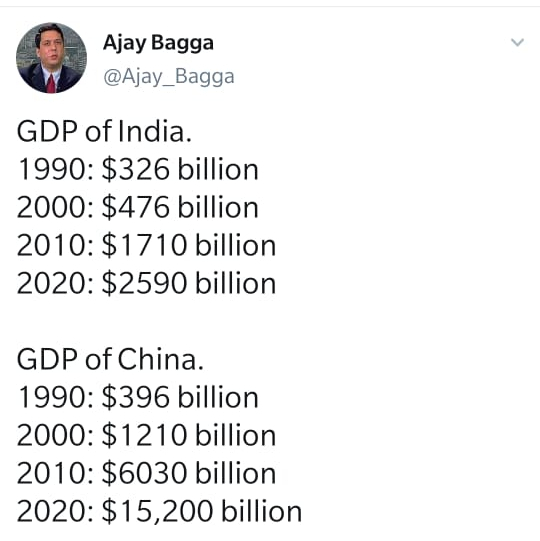
While China focused on becoming the manufacturing hub of scale for the world by focusing on its blue collar labour, India preferred to leverage its English educated younger population to focus on becoming the back office thereby creating white collar jobs. China’s decision of focusing on the blue collar jobs benefited them tremendously by putting more income in the hands of a larger cross section thereby creating a huge virtuous cycle of domestic demand. The success is clearly visible in the GDP growth over the last 30 years represented in the twitter quote from Ajay Bagga (one of the most respected experts in the finance industry).
When it comes to economic development, instead of wasting critical resources on pompous and chest thumping projects, even now, if India is able to prioritise execution of core infrastructure projects which focus on health , education and last mile connectivity, it can have a multiplier effect on the overall development trajectory to help us leapfrog.
Here is a good example of how just focusing on execution can help accelerate overall development : The 55 km sea way which connects Hong Kong to Macau and the mainland Chinese city of Zhuhai, was built by China in a matter of 9 years for USD 20 bln whereas the 5 km Mumbai sea link which took 10 years to build. The foundation stone was laid in 1999 and the original plan estimated the cost at ₹6.6 billion (US$93 million) to be completed in five years. But the project was subject to numerous public interest litigations, with the 5-year delay resulting in the cost escalating to ₹16 billion (US$220 million), and was inaugurated only in June 2009. It is investment in multiple projects like the 55 kms sea way, that China has been able to bounce back post COVID with a 4% GDP growth in Q3 v/s -23% for India in Q2.
The focus on infrastructure development will go a long way in India’s effort to meet the gap of 8.1 million jobs required to be created annually for the estimated 104.62 million fresh entrants in the labor market by 2022; against the just 5.5 million created in 2017, to keep employment rates constant between 2015 and 2025.
As we reflect, let me share with you some of India’s success stories on two key building block viz Birth control and Education which as can can go a long way.
Birth control -Kerala Model
Well , if you look around, in India Kerala is a very successful role model in the field of birth rate control through women’s education instead of state direction. So much so that in his seminal book The Argumentative Indian, Amartya Sen has brought a very interesting view about the total fertility rate for India. While for India as a whole it is still as high as 3.0, the rate in Kerala has fallen well below the ‘replacement level’ of 2.1 to 1. 7 (even lower than China’s fertility rate). Amongst some of the key factors which have enabled Kerala to deliver this is female literacy, women’s empowerment and agency, including a greater recognition of women’s property rights for a substantial and influential part of the community. As can be seen, the compulsion could not produce a lower birth rate in China compared with what Kerala has already achieved entirely through voluntary channels, relying on the education of women. When China introduced its ‘one child policy’ and other coercive measures, China had a fertility rate of 2. 8 while Kerala’s fertility rate was somewhat higher, at 3.0. By the early I990s, China’s fertility rate was down from 2.8 to 2.0, whereas Kerala’s had fallen from 3.0 to I.90. Kerala has remained ahead of China as fertility rates have continued to fall both in Kerala and in China.It so happens that Kerala not only has a much higher level of female literacy than India as a whole, it is also well ahead of China’s female literacy rate (and higher indeed than every province of China).
Telangana government aided or Delhi Government school Education Model
Even though according to the India Economic Survey 2017 by the Organisation of Economic Cooperation & Development (OECD), public spending on education in India is 3.8% of the GDP, much lower than countries such as Brazil and Malaysia, there have been some success stories which give us hope about being able to effectively utilise the allocated resources.
Both these successful models of Telangana government adid schools and the Delhi Government schools are based on the premise of “sense of involvement” towards being educated and creation of an infrastructure with a conducive environment which enables the pull factor towards education work, rather than the push.


For the record, this year, the Telangana Social Welfare Residential Educational Institutions Society (TSWREIS) and its sister organisation, the tribal welfare residential educational institutes (TTWREIS), which together run close to 400 schools where over 2 lakh children saw a record of sorts with 706 students clearing the intensely competitive Joint Entrance Exam ( JEE) Mains (qualifying rate of less than 2%), for which parents typically spend lakhs of rupees on private coaching. These institutions also focus on all round development of its students. This can be evidenced by a 13 year old member of a Scheduled Tribe school becoming the youngest girl in the world to climb the Everest summit (click here to know more:-https://economictimes.indiatimes.com/news/politics-and-nation/how-an-ips-officer-is-changing-the-fortunes-of-students-from-marginalised-communities-in-telangana/articleshow/78594703.cms?from=mdr)
Similarly the Delhi government schools “outperformed” private schools in 2018-19. The pass percentage in government schools was 90.68 per cent, whereas the pass percentage for private schools was 88.35 per cent. (Click here to know more: https://theprint.in/india/education/what-the-delhi-school-education-model-is-and-why-maharashtra-is-looking-to-emulate-it/350356/).
While education is one of the areas, another area which will help is skill development whereby individuals are trained to apply the knowledge of what they know for what they can do with what they know. I.e teach the students to extrapolate from what they have learned and apply that knowledge in unfamiliar settings, both in and outside of school. For this the execution of several programs such as the Vocational Training Institutes for Women, Basic Training Centers and Related Instructions Centers, and even Industrial Training Institutes that encourage practical skill development that the Government has already undertaken under its Skill India initiative can go a long way. These skill development programs ensure the country’s low skill intensity and low education attainment do not present a major challenge in preparing the workforce for India’s future.
Path ahead for India
I’m convinced that the diversity factor notwithstanding, a sound economic model based on three key factors viz – population control through women empowerment, education with focus on skill development coupled with speedy execution of core infrastructure projects and reforms to encourage setting up of more manufacturing facilities, can make a huge impact in meeting the dual objective of job creation and growth by putting more money in the hands of a larger cross section. India needs to leverage the current COVID adversity to direct all resources to focus on the three basic building blocks which can have a transformative impact on our economy. Cheers !
References:The Argumentative Indian by Amartya Sen – Kerala model
Acknowledgements : My Friend Ashish Parulekar and Sheetal Nagle for being a solid member of my blog support team.
P.S To read my other blogs on Cricketing / Corporate Tales, Start up stories, Finance, Covid Times, Friends, Family and Marriages go to the Home Page
 Salil's Blog
statistics are most powerful convincing and educaþive. concrete consumtion ,education and skill development in china is a must to leàrn for india now
LikeLike